Sự nào tại ta: What Fault Is Mine? Between Justice and Complicity
Who bears responsibility for the harm we do, allow, or suffer? Late in Truyện Kiều, Kiều finally holds power over the people who sold, deceived, and abused her. As the captives are led in, she declares that those who harm others will be harmed in turn – it is not her doing but theirs. We turned her words into a question and asked it of ourselves.
Sự nào tại ta? What fault is mine? That question shaped the third session of Kiều Lesen – Reading Kiều on 21 November at parallelgesellschaft × Galerie Nord in Berlin-Moabit, a few minutes from JVA Moabit, the city’s remand prison for men. Around 25 people came for an afternoon of film, conversation, and reading group.
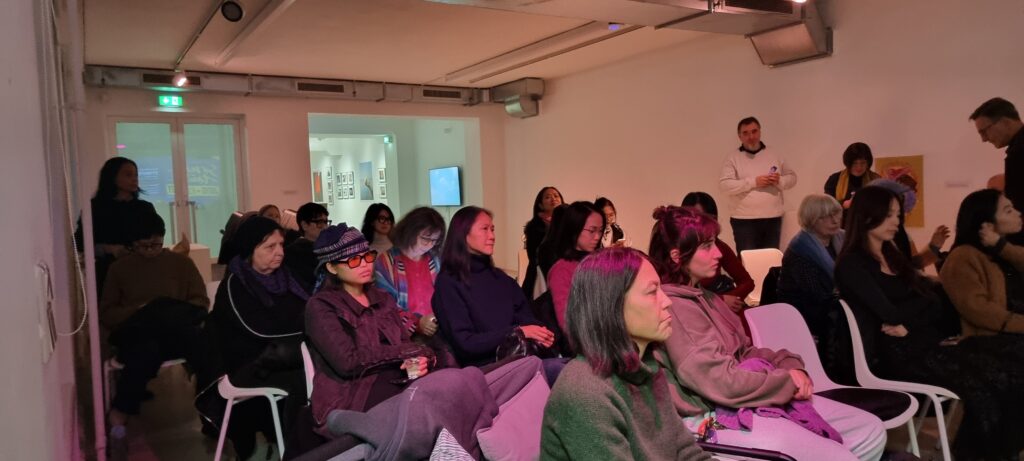
The audience at parallelgesellschaft × Galerie Nord.
We began with Stinkfrucht (Taste of Home), a short film Âni Võ made as a student at the University of Television and Film Munich (HFF München). Mai, 17, works without papers in a nail salon in Germany. When her trafficker comes to move her elsewhere, she runs away and asks 11-year-old Linh for help. Her mother runs the salon and is caught up in the same system, which reaches from Germany to Vietnam. When the traffickers threaten her younger sister back home, she has to choose between her own freedom and her sister’s safety.
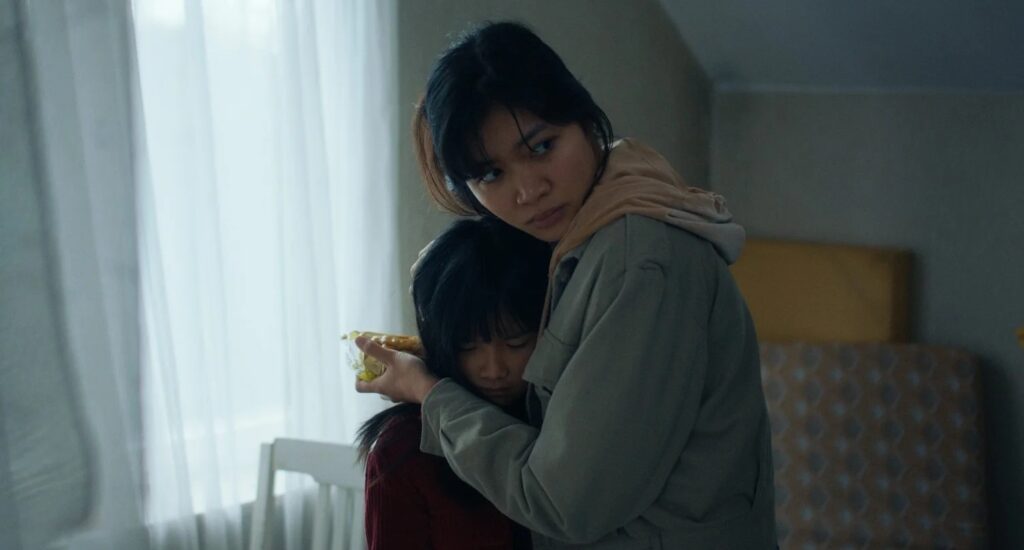
Nhung Hong (Mai) and Ngọc Nhi Hà Trần (Linh) in Stinkfrucht (Taste of Home), Âni Võ, 2022. Cinematography: Meret Madörin. © HFF München
Afterward, Amelie Mai Gottsmann spoke with Hang Hoang (Kompetenznetzwerk Vietnam) about how the film relates to real lives: the debts many people take on to come to Germany, the gap between what they were promised and what they find, and the courage it takes to seek help. Support exists, but people need to know where to find it – connecting them with it is what Kompetenznetzwerk Vietnam does.

Amelie Mai Gottsmann in conversation with Hang Hoang (Kompetenznetzwerk Vietnam) after the screening.
The title of our session comes from lines 2381–2382, spoken at the tribunal:
Lồng lộng trời cao,
Hại nhân, nhân hại, sự nào tại ta?
High Heaven towers over all!
It’s not my law that ill be paid with ill.
Translation: Huỳnh Sanh Thông
„O Himmel, unermesslich hoch! … Sie trugen Leid in andre Seelen, nun fällt es auf Sie zurück! Die Rache ist nicht mein.“
Translation: Irene & Franz Faber
Many Vietnamese editions print the line as a question, rhetorical but open. Huỳnh Sanh Thông turns it into a statement about law. The Fabers’ “Die Rache ist nicht mein” echoes Luther’s Bible (“Die Rache ist mein, spricht der Herr”) and hands judgment back to heaven. Each translation answers the question differently.
After a break, Pipo Bui, author of Envisioning Vietnamese Migrants in Germany (2003), introduced the poem through the lens of justice, injustice, and complicity. Then everyone drew a numbered slip and joined a group for one of six scenes. Each group had the verses in Vietnamese, German, English, and a literal translation, plus two questions linking the poem to the film.

Amelie Mai Gottsmann in conversation with Hang Hoang (Kompetenznetzwerk Vietnam) after the screening.
The six scenes were: the father who blames himself after Kiều sells herself to free him; the sale, where Nguyễn Du writes that luck is heaven’s doing; the promises of Tú Bà; the house where a housekeeper warns Kiều not to recognize anyone; Thúc Sinh, who stayed silent; and the tribunal.
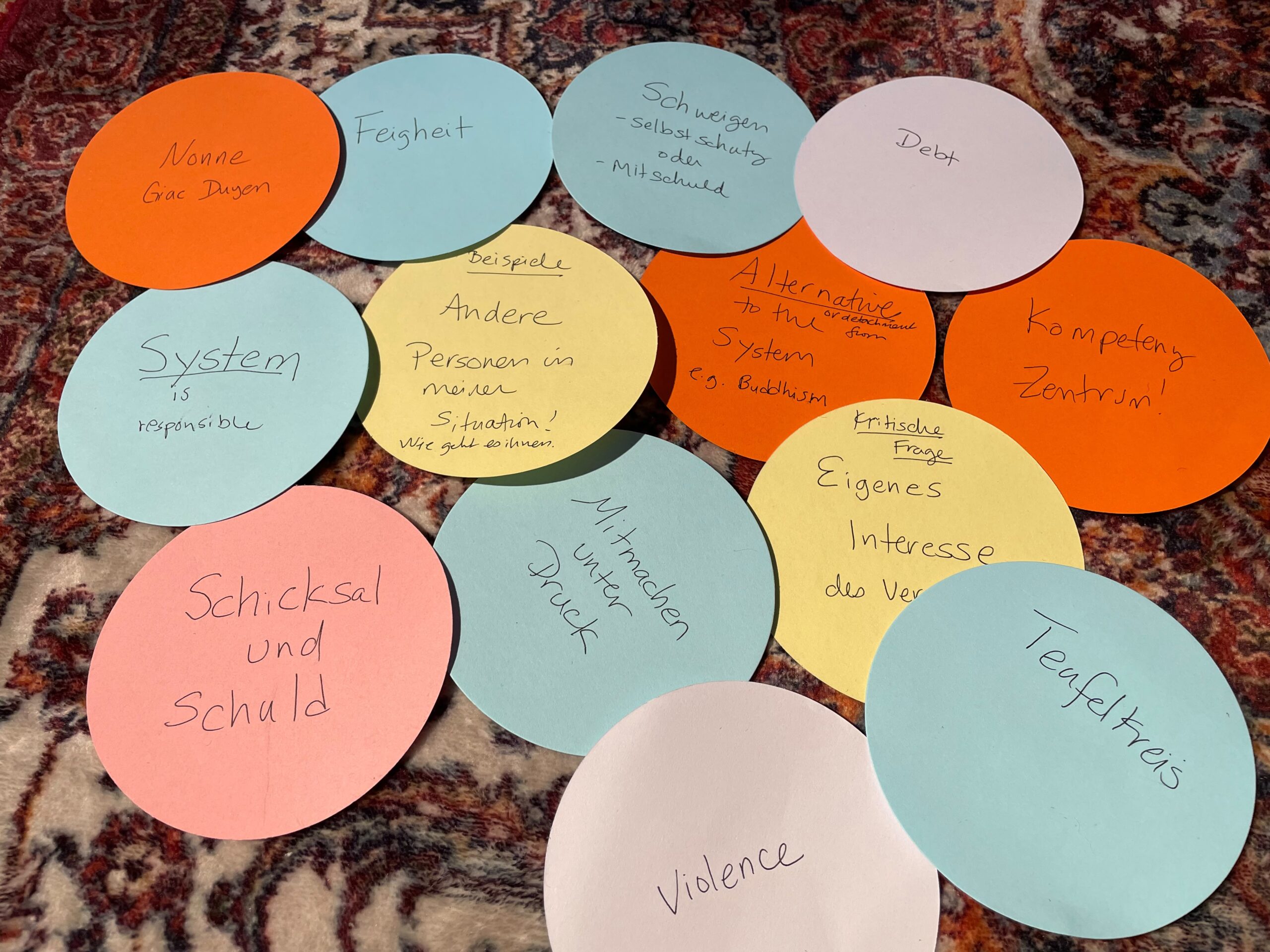
Back in the circle, the groups read their scenes aloud in order, from 1 to 6, and shared what they had talked about. Their key words ended up on paper circles: Feigheit. Debt. Schweigen – Selbstschutz oder Mitschuld? Mitmachen unter Druck. Teufelskreis. System is responsible.

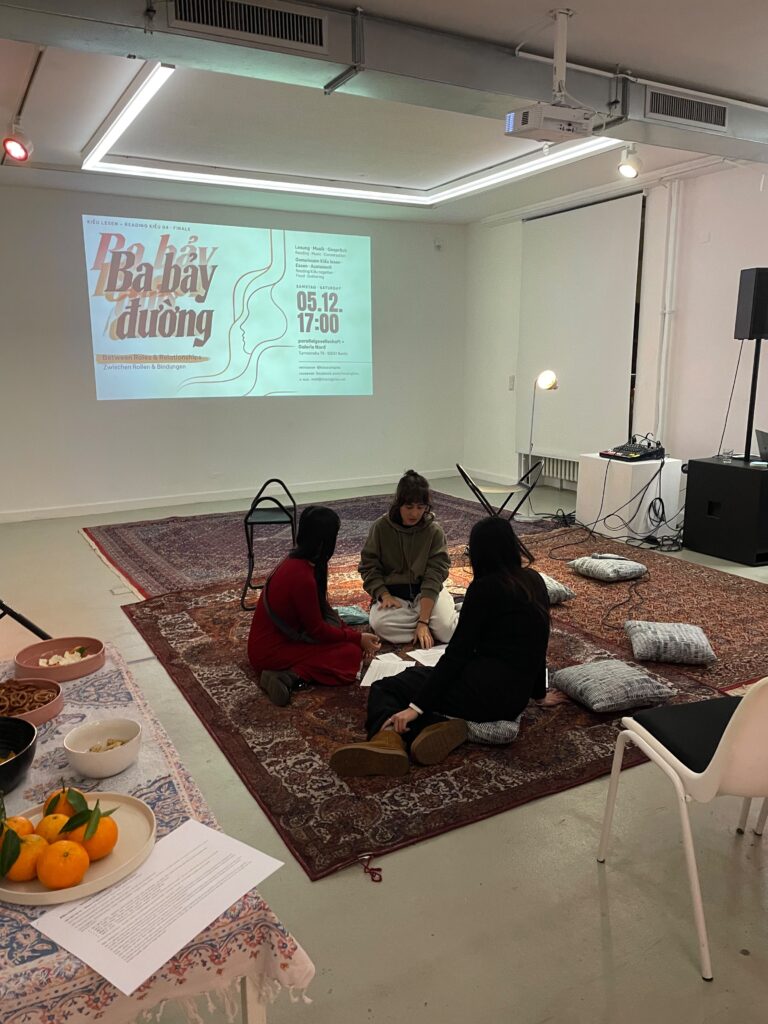
Six groups, six scenes: reading the verses in Vietnamese, German, and English.
On Saturday, 5 December, at 17:00, the series closes with Ba bảy đường – Three or Seven Paths, an evening of poetry, music, and contributions in Vietnamese, German, and English on the many roles of Kiều.