Băng lối vườn khuya: Crossing the Night Garden, Between Love and Constraint
How free is a choice when love and duty pull against each other? Early in Truyện Kiều, while her parents are away, Kiều lowers the silk curtain at the door and crosses the garden alone at night to meet Kim Trọng. Under the moon, they pledge to marry. Soon after, her father and brother are falsely accused, and Kiều sells herself to free them. She makes the choice herself. But how much choice does she have?
That question shaped the second session of Kiều Lesen – Reading Kiều on 31 October at parallelgesellschaft × Galerie Nord in Berlin-Moabit. About 60 people came for the evening combining music, poetry performance, artist talk, and reading group.
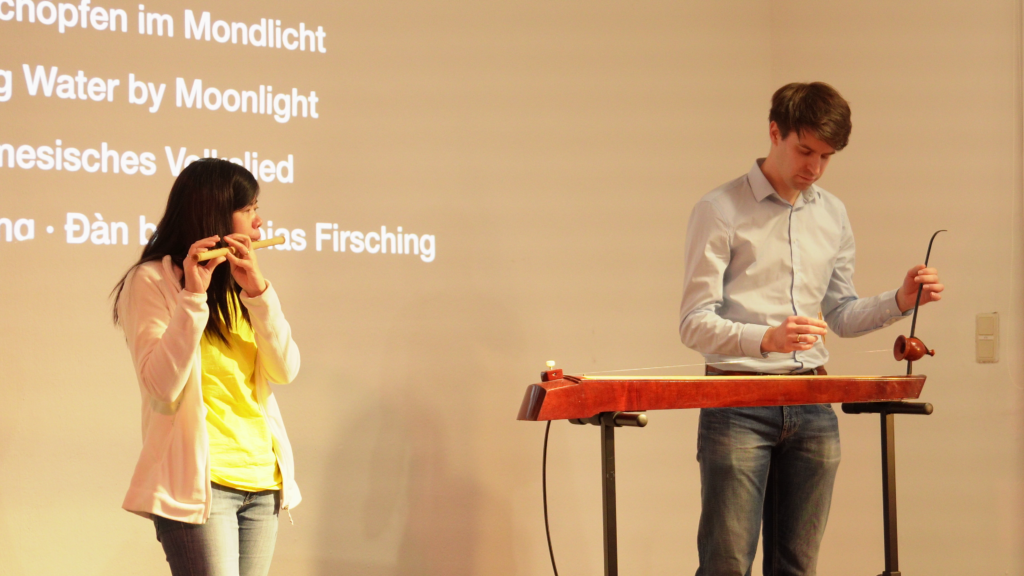
Mai Firsching and Tobias Firsching play Vietnamese folk songs on sáo trúc (bamboo flute) and đàn bầu.
The evening began with an introduction to the poem and to how Kiều has been pictured over two centuries, from an illustrated manuscript of the 1890s to a minimalist painting by Lê Thiết Cương from 2021. Sometimes she wears Chinese robes and holds a Chinese lute, and sometimes she wears Vietnamese dress beside a moon lute. Who tells her story changes how she looks.
Then came Băng lối vườn khuya, an artistic sequence developed by poet Dạ Thảo Phương.

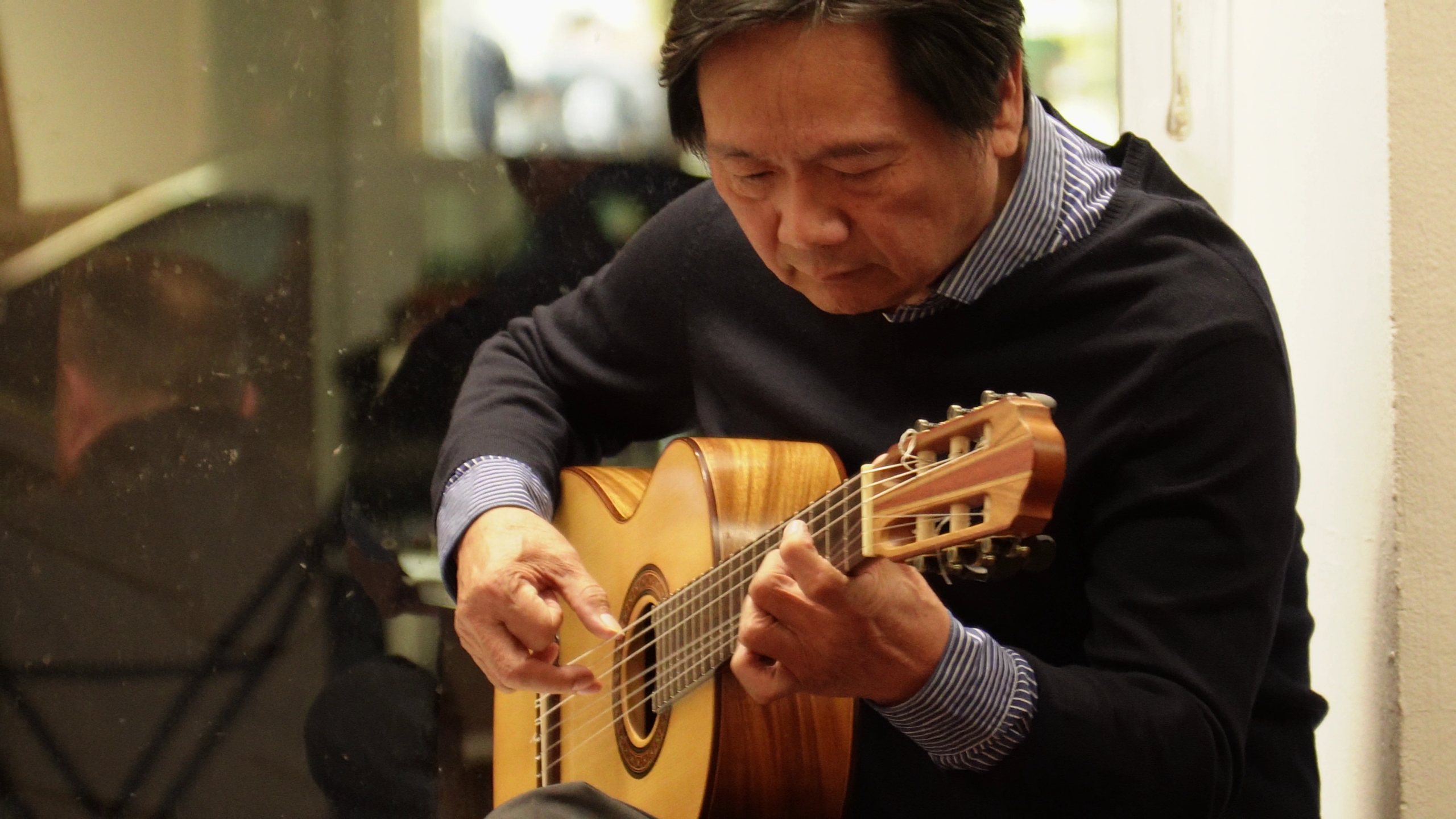
Đặng Ngọc Long plays from his Suite Kiều beside the readers Lưu Bích Ngọc, Amelie Mai Gottsmann, and Alisa Anh Kotmair, who read excerpts from Truyện Kiều in Vietnamese, German, and English.
The screen goes dark. Sitting at the window, Đặng Ngọc Long opens with the prelude from his Suite Kiều for guitar. A bamboo flute answers from among the audience: Mai Firsching, playing a folk song as if to herself. Tobias Firsching brings her to the stage, where the đàn bầu is waiting, and the two play face to face, a conversation in music.
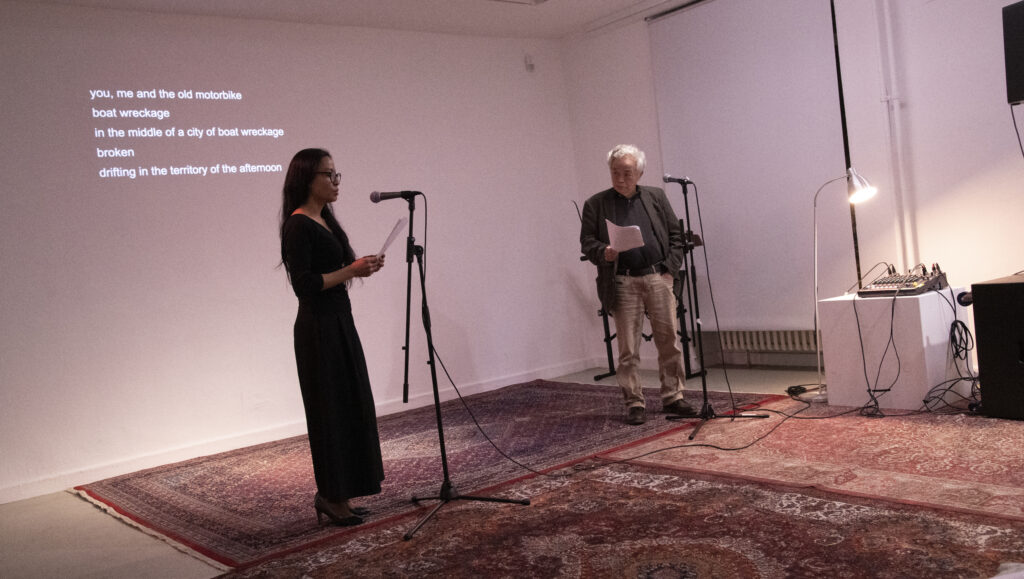
Dạ Thảo Phương reads her poem “Bản tình ca của những mảnh thuyền” (A Love Song of Boat Wreckage), with Hoàng Đăng Lãnh reading his German translation, “Liebeslied der Bootstrümmer.”
Then come three scenes from the poem in three languages: the vow, the injustice, and the decision. Lưu Bích Ngọc reads in Vietnamese, Amelie Mai Gottsmann in German, and Alisa Anh Kotmair in English. When the bailiffs storm the house, the reading speeds up. Long’s “Oán khúc” (Lament) plays behind the readers before Kiều makes her choice. The scene ends with the narrator: she who thinks nothing of her own life cares even less for the loss of love. Then there is silence.
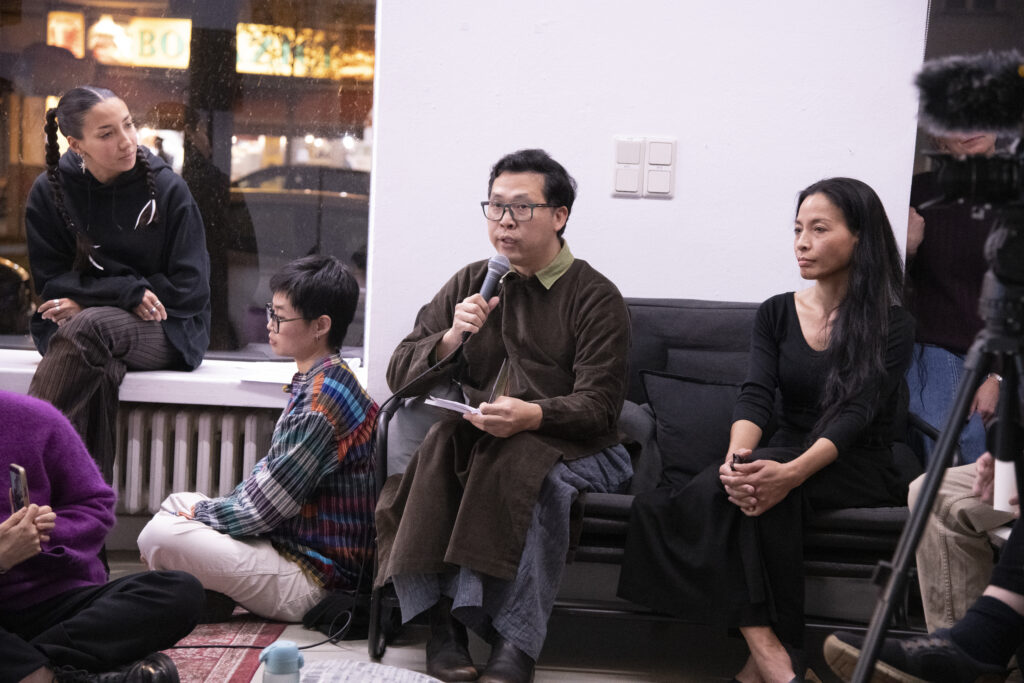
Seated among the audience, Marcus Mạnh Cường Vũ begins reading from his new poetry collection, Hành trình tự do đi Sao Hỏa (A Journey of Freedom to Mars).
From there, the sequence moves into the present. After Long’s “Bão tố” (Storm), Phương reads her poem “Bản tình ca của những mảnh thuyền” (A Love Song of Boat Wreckage). Hoàng Đăng Lãnh follows each section with his own German translation, while the English text and photographs appear on the screen. Marcus Mạnh Cường Vũ closes with a poem and video from his poetry collection Hành trình tự do đi Sao Hỏa (A Journey of Freedom to Mars). He reads the Vietnamese seated, then moves into the center to read the German, followed by a short video animation with music.
In a short artist talk, Amelie spoke with the performers and with the two artists whose images framed the evening. Claudia Borchers drew a kind of emblem that distills the story’s themes, which appears on the cover of the 2015 reissue of Irene and Franz Faber’s German translation. JP Bouzac paired a contemporary Kiều with a butterfly, a nod to the verse that recalls Zhuangzi’s dream of being a butterfly.
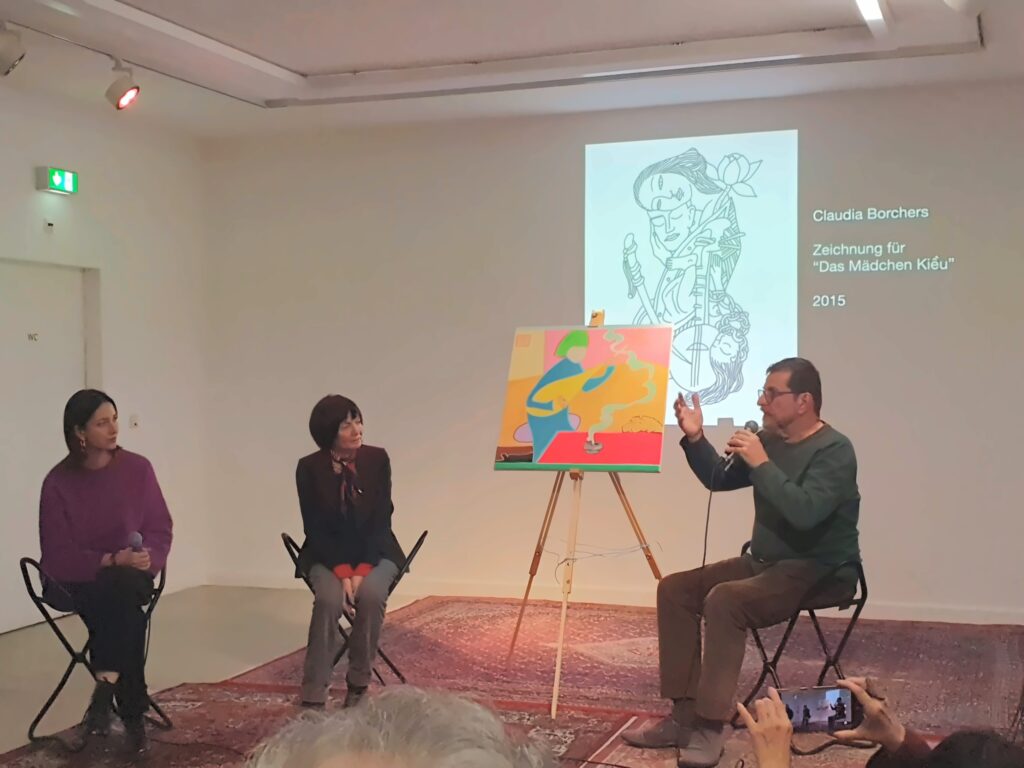
In the artist talk, Claudia Borchers, cover artist of Das Mädchen Kiều, and JP Bouzac speak with Amelie Mai Gottsmann about their images of Kiều.
The title Băng lối vườn khuya comes from lines 431–432, where Thúy Kiều, with her parents away, crosses the garden alone at night to meet Kim Trọng. For a young woman of her standing, it is a bold step, an act of choosing for herself:
Cửa ngoài vội rủ rèm the,
Xăm xăm băng lối vườn khuya một mình.
She dropped silk curtains at the entrance door,
then crossed the garden in dark night, alone.
Translation: Huỳnh Sanh Thông
… ließ sie schnell die Vorhänge der Tür herunter und begab sich flinken Schrittes in den Garten. Draußen war es Nacht geworden.
Translation: Irene & Franz Faber
After a break, about 20 of us returned to the same verses with a handout setting the Vietnamese beside German, English, and literal translations. Some details only appear side by side: in Vietnamese, Kiều crosses the garden xăm xăm, with quick, determined steps, and that determination fades in translation. The word “freedom” never appears in these verses, yet the question runs through all three scenes.
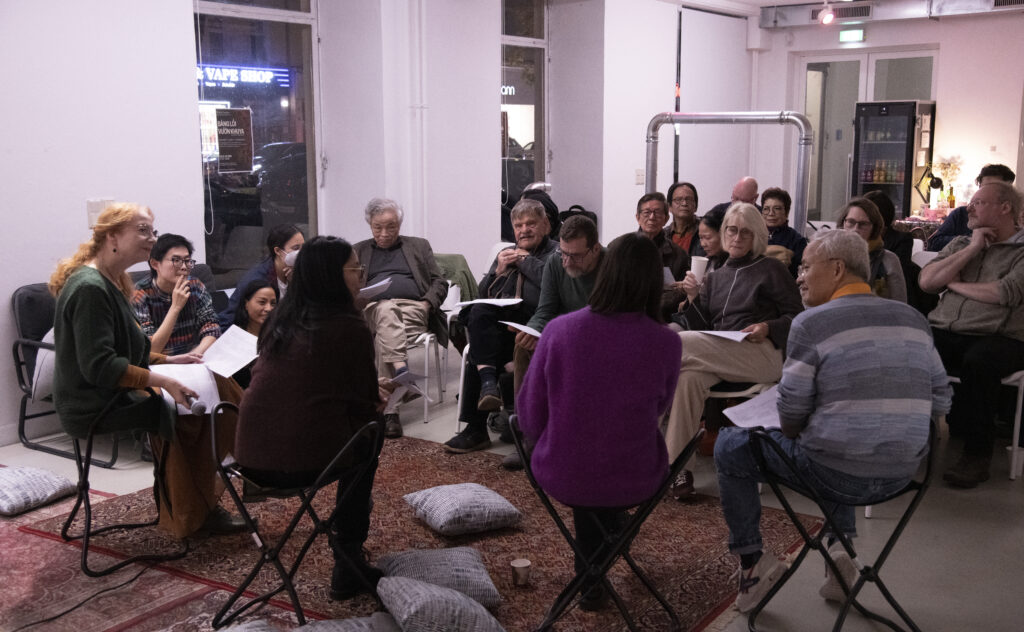
About 20 people stay for the reading group, going back over the evening’s verses with the Vietnamese, German, English, and literal translations side by side.
Excerpt from Kiều Lesen #2 – Băng lối vườn khuya. Video: Minh Cao Larsen, Frank Zeller; Photos: Đỗ Quang Nghĩa, Nico Schröder · Edit: Alisa Kotmair
The next session moves from love to responsibility. On 21 November, Sự nào tại ta – What fault is mine? pairs Âni Võ’s short film Stinkfrucht with a reading on injustice and complicity. On 5 December, the series closes with an open session on Kiều’s many roles. Bring your own texts!